
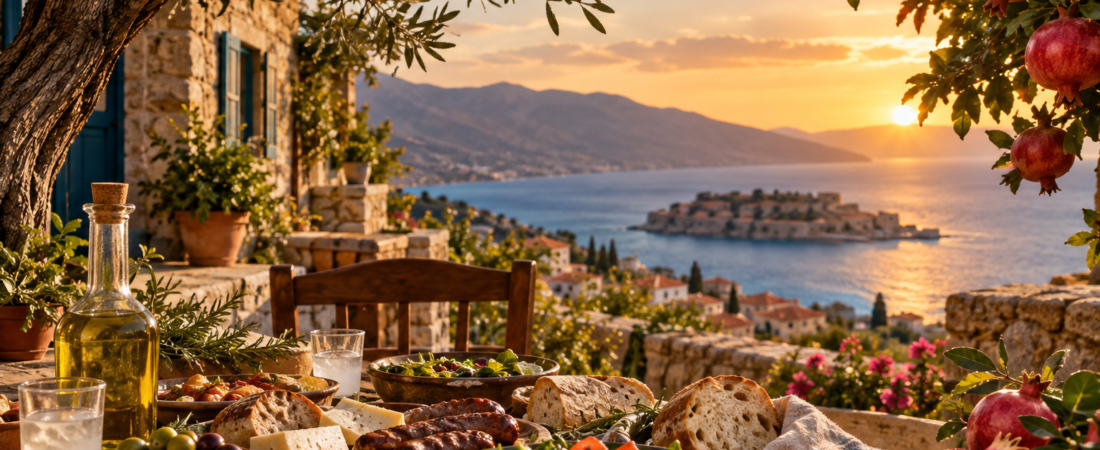
I travelled to Greece at a time when much of the world was talking about what the country had lost. Somewhere in Crete, I began noticing what it had never stopped valuing.
Somewhere in Crete, in a stone house belonging to a retired couple who had no particular reason to make an Indian visitor feel at home, I stopped feeling like a visitor. There was no grand moment when this happened.
Perhaps that is why I remember it.
Their daughter was grown and married. They were retired and seemed to possess something that many of us spend our lives gradually surrendering: time. Meals did not feel hurried. Conversations did not have to arrive anywhere. There was always something being prepared, explained, poured, picked, made or remembered. I spent more time with them than I had expected to. And through them, I began discovering Crete.
Arriving at a difficult moment
I had come to Greece around 2015–16, not long after defending my doctoral dissertations and while exploring further work and study around communities and the social sector. A group of us—friends and acquaintances spread across Europe, Africa and elsewhere—had formed an informal circle of young social thinkers. We had the sort of ambition that seems entirely reasonable when you are younger: perhaps, by bringing together people from different countries and disciplines, we could help communities solve problems.
There was even a slightly playful comparison among us to an Avengers-style initiative. Through that circle I became close to two people from Greece. One became a mentee. Another friend was exploring an idea around preserving and presenting Cretan culinary traditions. That idea eventually took me to Greece. The timing was extraordinary.
Internationally, Greece was being discussed through the vocabulary of crisis: sovereign debt, austerity, unemployment, bailouts, banks and the future of the euro. In 2015, unemployment remained close to a quarter of the labour force. Banks closed temporarily, capital controls were introduced and cash withdrawals were restricted as the confrontation between Greece and its creditors reached its most dramatic point.
As an economist, those were familiar categories. But countries are strange things. They can look one way in economic data and quite another across a dining table. Crete began teaching me that distinction.
An island that took its food seriously
We travelled widely across the island. There was Agios Nikolaos and the sea, where fishing gave seafood an immediacy that is difficult to reproduce once food has travelled through warehouses, supermarkets and restaurant kitchens. There was Rethymno, where I remember being struck by the pace of life. Chania gave me something closer to the countryside experience I had imagined Greece might offer. Heraklion brought vineyards and wine more strongly into the journey.
But increasingly, the places became less important than what people did in them.
I learned about making raki—the Cretan spirit more properly known as tsikoudia. I watched traditional approaches to wine. I learned about olive oil extraction. There were cheeses and fresh sheep’s-milk yoghurt. There were sausages, which I particularly enjoyed learning to make. And there was meat. Plenty of it. What interested me was not simply what people ate, but how foods existed together. Meat sat comfortably alongside vegetables, greens, yoghurt, cheese, olive oil, fruit and wine. The meal was an ecosystem rather than a collection of isolated indulgences.
Later I would understand more clearly that what I had encountered was not incidental. Cretan institutions themselves describe the island’s cuisine as something larger than a collection of dishes—a way of life rooted in local produce, vineyards, olive oil and recipes carried across generations.
At the time, however, I was not analysing it. I was eating. And learning. And occasionally making a mess while trying to make sausages.
The things people know
Travel becomes more interesting when you stop asking only what a place has and begin noticing what its people know.
- Someone knew how the sausage should be made.
- Someone knew how the raki should taste.
- Someone knew the olives.
- Someone knew the cheese.
- Someone knew the wine.
These were not necessarily people who would have described themselves as custodians of cultural heritage. Much of the knowledge simply existed because somebody before them had taught them, and somebody before that had taught the previous generation. The continuity fascinated me. Even hospitality seemed connected to it. Food was rarely only food. It was an invitation to remain at the table a little longer. I began noticing other small things too.
Pomegranate trees appeared around homes. When I asked about them, I was told that they brought luck. It was a tiny explanation, offered casually. But I remember it years later. That is often how culture survives—not through declarations about preserving culture, but through ordinary acts whose meanings everyone seems to understand.
A tree older than our certainties
Crete also rearranges one’s sense of time. Among its olive groves are trees whose lives are measured not merely in centuries but in millennia. The famous monumental olive tree at Vouves, in the Chania region, is still living and producing fruit; estimates of its age extend into several thousand years. Standing around olive trees of extraordinary age does something peculiar to one’s sense of importance.
Governments change. Economies rise and contract. Currencies appear. Political systems disappear. Entire arguments that once seemed urgent become paragraphs in history books. The tree remains. People harvest from it. And somewhere along that chain of generations, knowledge continues to move from one person to another. For an economist, it raises an uncomfortable question.
What exactly do we mean by wealth?
The island across the water
Not everything I encountered in Crete was idyllic. From Plaka, there is another island.
Spinalonga sits just offshore, beautiful from a distance and considerably more complicated once you understand its history. For much of the first half of the twentieth century it served as a leprosy colony. Its houses, streets, fortifications and institutional remains preserve the memory of people who were separated from wider society because of disease.
I already knew something of Spinalonga through Victoria Hislop’s The Island. Seeing the place itself made the story less literary. What stayed with me was that difficult history had not simply been erased. Crete seemed comfortable carrying many versions of itself simultaneously: Minoan civilisation, mythology, Venetian remains, painful modern history, villages, vineyards, tourism, agriculture and contemporary life. Its past had not been tidied into a single convenient story. It was simply there. Perhaps that was another form of confidence.
The strange familiarity of somewhere foreign
I travelled beyond Crete as well—to Rhodes and Athens—and spent considerable time around museums, archaeological sites and the remains of worlds that had shaped Western civilisation. Greek mythology had fascinated people for centuries. Coming from India, however, I sometimes found the experience unexpectedly familiar. The gods were different. The stories were different. The civilisations had developed thousands of kilometres apart.
Yet certain human preoccupations seemed remarkably recognisable: gods behaving like people, families and dynasties, war, loyalty, betrayal, fate, pride, sacrifice, heroes attempting to negotiate with forces larger than themselves. I wasn’t trying to establish some historical connection between Greek and Indian mythology. What interested me was simpler. The farther I travelled from home, the more frequently I encountered things that reminded me of it.
And nowhere did that become clearer than around food.
“Bring curcumin”
There was one request I heard repeatedly enough to remember. Older people I knew in Greece would tell me that when I returned from India, I should bring curcumin. At first I found this slightly amusing. I was Indian. Turmeric was hardly exotic to me. It belonged to kitchens. It was something so familiar that familiarity itself had stripped it of mystery. They saw something else.
They saw value.
Only later, after returning to Northeast India, did I properly encounter the story of Lakadong turmeric from Meghalaya. Lakadong is now protected by a Geographical Indication. It comes from the Jaintia Hills of Meghalaya and is distinguished by unusually high curcumin levels; Meghalaya government sources place the range substantially above that of ordinary turmeric varieties.
The irony was difficult to miss.
I had travelled thousands of kilometres from Northeast India before people in Greece helped me become curious about something growing almost next door to where I came from. That stayed with me.
Looking homeward
The most important thing Crete gave me was therefore not a favourite dish, a bottle of wine or a photograph. It gave me a question. Why do some societies instinctively recognise value in what they inherit while others sometimes learn to recognise it only after somebody from outside does?
Northeast India has extraordinary food traditions. We have ingredients found in particular landscapes, fermentation traditions, agricultural knowledge, indigenous practices, textiles, languages, stories, music and communities whose identities have developed across generations.
Yet growing up, I don’t remember us always treating these things as assets. Too often, modernity seemed to require moving away from what was local. Something imported appeared sophisticated precisely because it came from elsewhere. Something inherited could become ordinary simply because we had always had it.
Crete complicated that assumption for me.
The people I met did not appear embarrassed that their identity remained connected to olives, wine, cheese, villages, recipes and traditions. They had not confused modernity with cultural amnesia. And importantly, this was happening in a country experiencing one of the most difficult economic periods in its recent history. That distinction matters.
I don’t want to romanticise the Greek crisis. Economic hardship was real. Unemployment was extraordinarily high. Families and businesses faced genuine uncertainty. Capital controls and banking instability were not abstract inconveniences. But economic distress had not automatically erased cultural confidence. A country could be financially wounded without becoming ashamed of itself. That was perhaps the most important thing I saw.
Another kind of capital
Economics gives us many useful ways of measuring wealth. Income. Assets. Productivity. Investment. Capital formation. Employment. We need all of them.
But travelling through Crete made me think about forms of capital that rarely sit comfortably inside those categories.
- A recipe passed from grandmother to granddaughter.
- Knowledge of when to harvest an olive.
- A method of making cheese.
- A grape variety associated with a particular landscape.
- A fishing ground understood across generations.
- A pomegranate tree planted because somebody believes it brings luck.
- A stone house that continues to shelter another generation.
- A story a community refuses to forget.
None replaces economic prosperity. But neither is economically meaningless.
Culture can generate tourism, agriculture, food businesses, crafts, exports and livelihoods. More importantly, it gives economic activity something markets alone cannot manufacture easily: distinctiveness.
Places become valuable partly because they remain places.
What travel sometimes does
I had gone to Europe as part of a group of people thinking about communities and how we might contribute to them. Looking back, there is a certain youthful confidence in that idea. We imagined ourselves travelling around the world helping communities. Then a community quietly educated me.
- Not through a conference.
- Not through a university.
- Not through an economic model.
Through stone houses, long meals, fishing boats, vineyards, olive trees, sausages, cheese, raki and the generosity of two retired people who had enough time to allow a visitor into their lives.
Years later, when I began thinking seriously about Saboreso, a publication devoted to food, place and the cultures that connect them, I found myself returning mentally to Crete.
The idea did not begin there in any formal sense. But one of its earliest seeds probably did. Because Crete had taught me to see food differently.
- Food could be history.
- Food could be geography.
- Food could be agriculture.
- Food could be memory.
And food could tell you whether a society still recognised the value of where it came from. I travelled to Greece during a period when much of the world was discussing everything the country had lost. I came away thinking about everything it had managed to keep.
And somewhere between Crete and Northeast India, I learned something else. Sometimes we travel very far to discover a place. Sometimes, if we are fortunate, the place teaches us how to come home.