
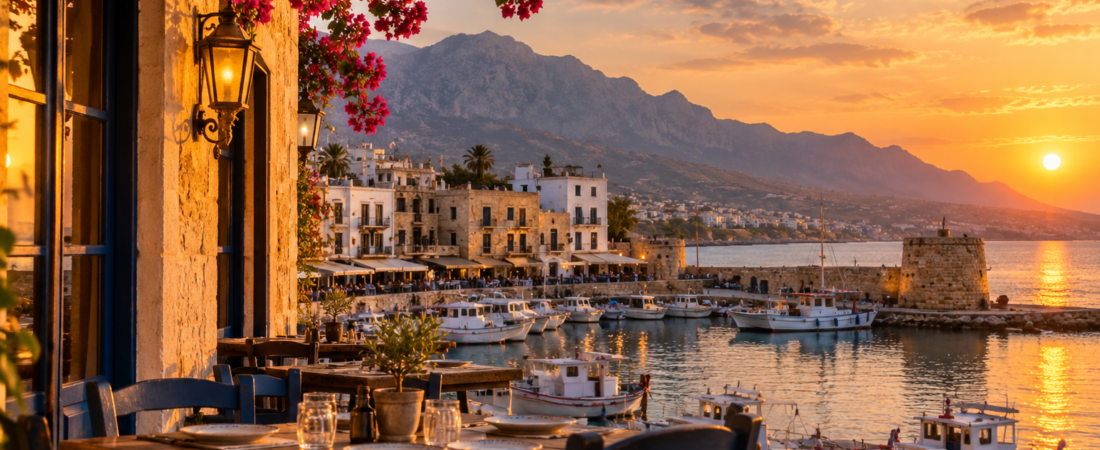
I went to Cyprus to understand which businesses could survive a financial crisis. What stayed with me was how people helped one another survive it.
It was towards the end of 2008, a year that had shaken much of what the financial world had taken for granted. Lehman Brothers had collapsed, confidence in financial institutions had deteriorated, and the consequences were travelling far beyond the markets where the crisis had originated. Businesses that had spent years building their operations were suddenly confronting uncertainties they had neither created nor fully understood. Credit was becoming harder to obtain, customers were becoming cautious, and the assumptions on which many enterprises had planned their future were being questioned.
I was working in financial analysis and investment consulting at the time. Much of my professional attention was directed towards understanding what the crisis meant for businesses and whether investment opportunities existed among enterprises struggling with its consequences. Cyprus became one of the places where that work took me.
Before travelling there, I knew Cyprus in much the same way many people outside the region understood it. It was a Mediterranean island with a complicated political history, divided between Greek Cypriot and Turkish Cypriot communities, with questions of territory, sovereignty and identity that had remained unresolved for decades. Its geographical position had also made it an important meeting point for different cultures and commercial relationships.
Those were the familiar descriptions. They were not necessarily wrong, but they were incomplete.
When I arrived, the concerns I encountered in the course of my work were considerably more immediate. People were trying to sustain their businesses, protect their incomes, maintain relationships with suppliers and find some degree of certainty in an economic environment that offered very little.
I had gone there to examine businesses. I found myself paying closer attention to the people who kept them alive.
The economy beyond the headlines
Financial crises are often described through numbers. We measure the contraction of economic activity, the deterioration of asset values, the decline in lending, the collapse of investor confidence and the interventions required to prevent wider instability. These are necessary measures. Without them, it would be difficult to understand the scale of a crisis or design an appropriate response.
But numbers have a way of making the consequences appear more distant than they really are.
A restaurant facing declining revenue is not simply a business recording weaker sales. There is an owner wondering how to meet the next set of obligations, employees depending on wages, suppliers expecting payment, and families whose spending depends on those relationships continuing. A delay in one payment can become a delay somewhere else. A reduction in purchases can affect a producer who has already committed resources to supplying goods. A business that closes can leave behind consequences that are not captured by its final accounts.
These relationships are especially important in smaller enterprises, where the distinction between business and household finances can be narrow and where commercial arrangements are often sustained by years of personal familiarity.
During that period, I was interested in enterprises that had experienced financial difficulty but had not necessarily lost the ability to operate successfully. There is a significant difference between a business whose underlying economics are unsustainable and one whose prospects have been damaged by circumstances outside its control. Both may appear distressed on paper. Yet the decisions they require are very different.
I have never been comfortable with the idea that investment should be justified primarily by promises of extraordinary future growth. Growth can be valuable, but it cannot indefinitely substitute for a functioning business model. I wanted to see genuine progress, a credible plan for cash flow and evidence that the people responsible for the enterprise understood how to sustain it.
In Cyprus, I became particularly interested in the food and hospitality sector. Food occupied an important place in the communities I encountered. It was commerce, certainly, but it was also connected to everyday routines, local relationships, family livelihoods and a sense of place. Restaurants and small food businesses were not merely selling a product. They were participating in a wider network of producers, traders, workers and customers.
I began to wonder whether some of these businesses possessed a kind of resilience that their immediate financial circumstances concealed. It was a question worth testing rather than simply discussing.
A small restaurant and a different understanding of resilience
I eventually invested USD 15,000 of my own money to acquire a small restaurant-bistro.
It was not a large investment in the context of international finance, and I do not regard it as a remarkable amount. At the time, however, it was a meaningful personal commitment. More importantly, it gave me an opportunity to examine whether my assessment of the business was correct.
I retained the original owner and the existing staff to continue operating the restaurant. That decision was important to me. I had not acquired the business because I believed that replacing the people who knew it would automatically improve its performance. The owner understood the operation, the employees knew their work, and the restaurant already had relationships that would have taken time to rebuild if they were lost.
The business was facing pressure, but pressure alone did not mean that everything about it was failing. What it needed was sufficient financial breathing room to continue functioning without every decision being dominated by immediate uncertainty.
The first benefit of that support was not some dramatic expansion. It was considerably more ordinary. Employees could continue earning their livelihoods. The business could continue operating. The people involved had greater reason to believe that their work would not disappear simply because the wider economy had become unstable.
I have often returned to that experience when thinking about what resilience actually means. We tend to describe resilience as the ability of a business to withstand difficulty. In financial analysis, we might look at liquidity, leverage, margins, reserves and the ability to meet obligations under adverse conditions. All of these are important. I would not dismiss any of them.
Yet there is another part of resilience that is more difficult to capture in a financial statement. It is the confidence of people that their efforts still have a future.
When employees believe that a business may close at any moment, their uncertainty becomes part of the business’s operating environment. When suppliers doubt whether they will be paid, commercial relationships become more cautious. When an owner spends every day responding to immediate financial threats, there is less room to concentrate on customers, operations and the ordinary improvements on which a business depends.
A relatively modest amount of capital, applied to an enterprise that remains fundamentally viable, can sometimes change those conditions. It does not guarantee success. It does not eliminate commercial risk. Nor does it excuse poor management or make every struggling business worth rescuing. But it can allow people to return their attention to the work of running an enterprise.
Over the following three months, the restaurant’s performance gave me confidence that my initial judgement had been justified. What I had hoped to find was not a business capable of producing spectacular growth, but one capable of sustaining itself when the immediate pressure was reduced.
The experience strengthened a conviction I already held: investment should support demonstrated capability and credible financial sustainability, rather than depend entirely on an optimistic projection of what a business might someday become. At the same time, it began to show me something that went beyond the restaurant itself.
The business does not end at its doors
When we evaluate an investment, we generally begin with the enterprise receiving the capital. We examine its financial condition, management, market, assets and expected performance. The question is whether the investment can produce an acceptable result. That is necessary, but it is not always sufficient to understand the wider significance of a business.
A restaurant depends upon an entire chain of economic activity. Someone grows or produces the ingredients. Someone transports them. Someone supplies equipment, packaging or other necessities. Employees earn wages and spend part of those earnings in other establishments. The owner maintains commercial relationships that may have developed over many years. Customers contribute to the continued circulation of money within the surrounding economy.
When the restaurant struggles, those relationships can weaken. When it survives and begins recovering, they have a better chance of continuing. This is what I have come to describe as the butterfly effect of enterprise.
I do not mean that a small investment automatically produces an enormous economic transformation. Such claims are easy to make and much harder to demonstrate. Nor do I mean that every enterprise generates the same wider benefits.
What interests me is the way one decision can influence a series of other decisions, often beyond the immediate view of the investor.
The financial support provided to the bistro was directed at a particular business. But the people working there were connected to other people, and the restaurant’s purchases and payments were connected to other enterprises. Its continued operation helped preserve relationships that would otherwise have been placed under greater pressure.
The value of keeping an enterprise alive cannot always be understood by examining its balance sheet alone. There is an economic dimension to this, but there is also a human one.
A supplier who retains a reliable customer has greater reason to continue production. An employee who receives wages can continue meeting household obligations. A business owner who regains some financial stability may become more willing to make necessary operational decisions. These effects are not unlimited, and they depend on the circumstances of each enterprise. But they are real considerations when trying to understand how local economies function.
Perhaps most importantly, visible stability can influence confidence. During a crisis, uncertainty spreads through observation as much as through formal economic indicators. People see businesses closing, hear of customers failing to pay and become more cautious about their own commitments. Sometimes that caution is entirely justified. Yet when everyone withdraws at once, the resulting contraction can place additional pressure on businesses that might otherwise have remained viable.
The reverse process is neither automatic nor equally powerful, but it matters. When people see a business continuing to operate, meeting obligations and gradually recovering, it can provide a reason to maintain relationships rather than abandon them.
This was the aspect of the restaurant experience that remained with me most strongly. I had invested in one enterprise. I was beginning to understand more clearly the network of economic relationships surrounding it.
The Cyprus I remember
There was, however, another dimension to Cyprus that I had not expected to become so important to my understanding of the place.
The island’s political division was part of its history and remained part of its reality. The differences between Greek Cypriot and Turkish Cypriot communities could not be dismissed simply because an economic crisis had arrived. The historical grievances, questions of property, displacement and political identity were substantial, and I would not pretend that a visitor could fully understand them through a limited period of professional engagement.
Nor would I suggest that the financial crisis somehow erased those differences. But the Cyprus I encountered through business relationships did not always resemble the island described primarily through its political divisions. I saw people trying to sustain their livelihoods, and I saw cooperation across communities in the practical matters of commerce and survival.
Supplies, economic assistance, relationships and networks mattered. People looked for ways to support one another because the continuation of economic activity was important to their own lives and to the lives of those around them.
I did not experience these interactions as encounters between two entirely separate entities. I encountered people living on the same island, facing economic uncertainty and recognising forms of mutual dependence. This was not a comprehensive picture of Cyprus. It was the Cyprus visible to me through the people and enterprises with whom I interacted. That distinction is important.
A personal experience cannot establish how every community behaved, and it should not be used to minimise the political difficulties that remained. There would have been people whose experiences were quite different from mine. Economic hardship can bring communities together, but it can also sharpen existing tensions. Neither outcome should be assumed in advance.
What stayed with me was that, in the relationships I witnessed, the practical need to sustain livelihoods often mattered more than the categories through which the island was usually described. Someone needed supplies. Someone else had the ability to provide them. A business required support or a commercial connection. Another person could help establish it. These were not grand gestures of reconciliation. They were ordinary acts of economic cooperation. And perhaps that is why they made such an impression on me.
We often expect important changes in society to announce themselves through political agreements, institutional reforms or public declarations. Those things can be essential, particularly where historical conflicts remain unresolved. But much of everyday life continues through quieter relationships: people buying from one another, working together, sharing knowledge and finding ways to meet common needs.
Commerce does not necessarily dissolve political differences. It can, however, create circumstances in which people recognise that their own wellbeing is connected to the wellbeing of others.
I had travelled to Cyprus with an investment assignment. I had not gone there expecting to think deeply about how communities coexist. Yet the economic difficulties of that period exposed a form of interdependence that I found difficult to ignore.
What survival asks of people
There is a tendency, particularly when looking back on difficult periods, to describe hardship as though it naturally produces admirable qualities. I have never found that entirely convincing.
Financial distress is exhausting. It can damage relationships, weaken trust, force families into difficult decisions and leave businesses without the resources to recover. There is nothing inherently romantic about uncertainty over whether wages can be paid or whether a livelihood will survive another month.
People do not need a crisis in order to demonstrate their humanity. What a crisis can do is make certain relationships more visible. When economic conditions are favourable, it is easy to overlook how dependent enterprises are upon one another. A restaurant places an order, a supplier delivers, employees complete their work and customers pay. The system appears ordinary because its different parts are functioning.
When conditions deteriorate, those same relationships become sources of anxiety. The restaurant worries about customers. The supplier worries about the restaurant. Employees worry about wages. The owner worries about everyone, while also trying to meet obligations that do not disappear simply because revenue has declined.
A business is rarely an isolated financial unit, even when its accounts are prepared as though it were one. In Cyprus, this became particularly clear to me because the commercial relationships I observed existed within a society whose divisions were already widely recognised.
I had expected to examine the resilience of individual enterprises. I found myself thinking about the resilience of the relationships between them. There is a difference.
An individual business may possess a capable owner, a loyal workforce and a sound product. Yet if its customers disappear, suppliers withdraw or credit becomes inaccessible, its ability to continue operating may be severely limited.
Similarly, a community may contain many capable enterprises, but their collective strength depends partly upon whether they can maintain the relationships that connect them. Resilience, therefore, cannot always be understood as an individual quality. Sometimes it is sustained collectively.
That does not mean everyone contributes equally, or that cooperation eliminates competition. Businesses still compete for customers, negotiate prices and make decisions according to their own interests. But competition and interdependence are not mutually exclusive.
An enterprise can compete in one part of the economy while depending upon the health of that same economy for its own survival. This is particularly relevant to small businesses, where financial resources are limited and the failure of a few important relationships can have immediate consequences.
The lesson I took from Cyprus was not that goodwill could replace capital, nor that financial discipline should become secondary to social considerations. It was almost the opposite.
If we want enterprises to sustain livelihoods and support wider economic activity, they must themselves be financially viable. Investment decisions must be made carefully, and cash flow cannot be treated as an inconvenience to be solved indefinitely through further fundraising.
But financial viability is not separate from the people who create it. Trust, continuity, knowledge and commercial relationships are part of the conditions that allow a business to function. When those conditions are preserved, capital has a better chance of doing something useful.
From one enterprise to a wider investment programme
The experience of the bistro contributed to a wider investment programme in Cyprus.
Suadela Ventures subsequently confirmed an initial investment commitment of USD 2 million, directed towards smaller enterprises with potential to support economic activity and tourism.
I do not regard that commitment, or my role in the work surrounding it, as the central achievement of the Cyprus experience. The amount was meaningful to the businesses concerned, but it was modest relative to the scale of the international financial crisis and the economic forces affecting an entire country.
Cyprus did not depend on our investments for its recovery. Nor would I claim that our work transformed the island’s economy. Many people, enterprises, institutions and wider developments contributed to the country’s economic trajectory. My involvement was one small part of a much larger picture.
What mattered to me was the investment approach we were able to pursue. Rather than beginning with the ambition to create the next rapidly expanding enterprise, we examined businesses that already possessed operational experience, commercial relationships and the possibility of sustaining themselves with appropriate support.
The objective was not to eliminate risk. No investment can do that. It was to distinguish between enterprises that had lost their underlying viability and those whose ability to function had been weakened by the economic environment.
I also came to appreciate how valuable local relationships were to that process.
An external investor can study financial statements and market conditions, but those documents rarely provide a complete understanding of how a small enterprise operates within its community. The people already involved often know things that are difficult to reproduce through an outside assessment: which suppliers are dependable, how customers behave, what traditions matter and where the business has earned trust.
This was one reason I had retained the original owner and employees at the bistro. Their experience was not an obstacle to investment. It was part of what made the enterprise worth considering. And those relationships eventually carried the work beyond Cyprus.
Through the original bistro owner, I was introduced to opportunities connected with the olive oil industry in Andalusia, Spain. That relationship became part of a subsequent investment programme there, including investment in olive cultivation.
Spain deserves its own account. Its agricultural traditions, regional identities and the experiences surrounding those investments cannot be adequately explored in a few paragraphs.
For the Cyprus story, the connection matters for a simpler reason. A relationship that began with one small restaurant eventually opened a door to another industry in another country. It was another reminder that the consequences of enterprise-building are not always confined to the original investment. Some emerge through people and the relationships that continue long after the first financial decision has been made.
Looking back at Cyprus
Years have passed since that period, and I am conscious of how easily memory can simplify events. A financial crisis that once felt uncertain and unresolved becomes, with hindsight, a defined period in economic history. We know more about what followed, which institutions survived, which policies were introduced and how different economies eventually recovered.
But that knowledge can obscure what it felt like to make decisions when the outcome was still unknown. In 2008, I did not know how long the turbulence would last. I could not know whether the restaurant would recover or whether the investment opportunities we were examining would produce sustainable results.
I had a set of principles, a financial assessment and a willingness to test my judgement. The bistro gave me an opportunity to do that. Its recovery reinforced my belief that a business showing resilience and a credible path to cash flow could be worth supporting, even during difficult economic conditions.
Yet when I think about Cyprus today, the financial assessment is not what first comes to mind.
I remember the importance people attached to sustaining their work. I remember how much depended upon relationships that were easy to overlook from a distance. And I remember encountering cooperation between people whose communities were often discussed in terms of their differences.
The island’s political history remained complicated. It would be inaccurate to suggest otherwise.
But the people I encountered were not living only within the categories through which outsiders understood them. They were also employees, owners, suppliers, customers, neighbours and families trying to maintain a future.
That experience influenced the way I thought about the relationship between business and society. We often ask what an enterprise is worth to an investor. It is a legitimate question, and one that should be answered with financial discipline.
But I increasingly found myself asking another question alongside it: what economic relationships depend upon this enterprise continuing to function?
The answer does not necessarily justify an investment. A business must still demonstrate that it can sustain itself. There is little lasting benefit in providing capital without a credible path towards financial stability.
Nevertheless, the question changes what we notice. We begin to see employees as more than a labour cost, suppliers as more than a procurement expense, and local commercial relationships as more than transactions. We begin to understand that the health of an enterprise can affect the confidence and opportunities of people who may never appear in its financial statements.
This does not make the investor a saviour. I have never been comfortable with that description, and it would be particularly misplaced in a story involving an entire island and a global financial crisis.
The businesses I encountered already possessed people, knowledge, relationships and a determination to continue. Investment could provide support, but it could not substitute for those qualities.
If anything, the experience taught me to be more modest about the role of capital. Money can create breathing room. It can restore liquidity, finance necessary operations and allow a viable enterprise to continue working towards stability. But the lasting value comes from what people are able to do with that opportunity.
The same applies to the wider community. No single restaurant, investor or programme could resolve the economic uncertainty facing Cyprus. No amount of commercial cooperation could, by itself, settle the island’s political questions. Yet the ordinary relationships I witnessed mattered.
People continued finding ways to work with one another. Businesses depended upon networks that did not always fit neatly within political descriptions. The immediate concerns of livelihood and survival revealed connections that deserved as much attention as the divisions.
That is the Cyprus I carry with me.
Not an island without disagreements, and certainly not an island whose history could be understood through a brief investment assignment. Rather, a place where I encountered people who, in a difficult period, understood that helping another person or enterprise continue could also help sustain their own future.
I went there looking for resilient businesses. I came away with a deeper appreciation of the resilience that exists between people. And of everything I remember about Cyprus, that remains the most valuable part of the experience.